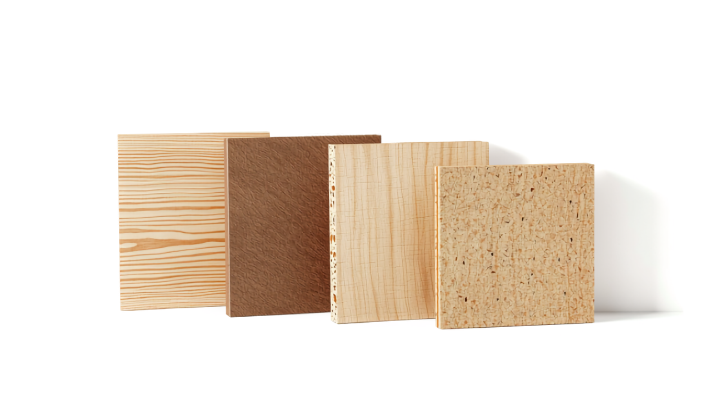
When designing custom furniture — whether for a retail store, a chain rollout, or a contract project — the choice of base board is one of the decisions that most affects the final result: durability, finish quality, cost, and how the piece performs under intensive use.
Not every board works for every purpose. A retail counter doesn't have the same requirements as a hotel bathroom cabinet, and a display unit doesn't behave the same way as an office wardrobe. This article covers the four most widely used board families in furniture manufacturing — particleboard, MDF, and plywood — explaining what they're made of, their key characteristics, and which type of project each one suits best.
What is a base board, and why does the choice matter?
A base board is the structural material a piece of furniture is built on, before any finish is applied (veneer, laminate, paint, melamine, etc.). All of these boards are made from processed wood — particles, fibres or veneer sheets — bonded with resin under heat and pressure. The difference lies in the size of those particles and how they're compacted, which determines key properties such as density, moisture resistance, machinability, and how well the material holds screws and fittings.
Choosing the wrong board doesn't always show up right away: it can show up months later, when an edge swells from humidity, a fitting works loose, or a surface can't handle the daily wear of a high-traffic space. That's why, in retail and contract projects — where furniture is subject to constant use and any failure has a visible cost to brand image — material selection matters as much as design.
Particleboard (Chipboard)
Particleboard, also known as chipboard, is made by pressing wood chips and particles with resin under heat and pressure. It's the most affordable of the four board types and one of the most widely used in mass-produced furniture.
Key characteristics:
- Medium density, with a more irregular internal structure than MDF.
- Good dimensional stability under normal conditions, though sensitive to moisture if edges aren't properly sealed.
- Less smooth surface than MDF, so it's almost always used with a finish (melamine, veneer or laminate) and doesn't machine well into complex shapes.
- Holds screws reasonably well with fittings designed for particleboard, though it loses grip after repeated disassembly.
Best suited for: A solid option when budget is a key factor and the piece won't be disassembled often or exposed to constant moisture: office furniture, shelving, internal cabinet structures, or display units that will later be finished with a surface material. In large-scale retail rollouts, where many stores need to be fitted out cost-effectively, particleboard is often the base for non-critical structural elements.
MDF (Medium Density Fibreboard)
MDF is made from wood fibres — finer than the particles used in chipboard — pressed together with resin. Those fine fibres give it a much smoother, more uniform surface, making it arguably the most versatile board for custom furniture with a high-quality finish.
Key characteristics:
- Medium-to-high density with a uniform structure, free of grain or knots.
- Ideal surface for painting, lacquering or applying high-pressure laminates, since it doesn't show the material's texture.
- Machines very well: allows for routing, curved profiles, mouldings and rounded edges with a clean finish.
- Moisture-resistant variants (MR MDF) are available for areas with moderate humidity.
- Heavier than particleboard at the same thickness, and sensitive to water if untreated.
Best suited for: The preferred choice when the design calls for shaped, painted or lacquered pieces: branded retail furniture, counters, decorative panels, drawer fronts and any visible element where the finish is critical. In contract projects — hospitality, premium offices, branded retail — MDF is often the reference material for its finish quality and versatility.
Plywood
Plywood is manufactured very differently from the other three: thin layers of wood veneer are stacked and glued together, with the grain of each layer running perpendicular to the one before it. That cross-grain structure is what gives plywood its main advantage — much higher structural strength relative to its weight.
Key characteristics:
- Excellent mechanical strength and flex resistance, even in large or cantilevered pieces.
- Good dimensional stability: it warps and swells less than particleboard or MDF under humidity changes.
- Excellent screw and fitting grip, even through repeated disassembly, making it ideal for modular or transportable furniture.
- Visible grain surface (unless covered), so it's used both with a natural/varnished finish and with a laminate covering.
- Higher cost than particleboard and, in premium grades, higher than MDF too.
Best suited for: The best option when a piece needs real structural strength: high-load shelving, demountable furniture for trade shows and events, travelling displays, outdoor or semi-outdoor furniture, and any piece subject to frequent assembly and disassembly — very common in temporary retail projects (pop-up stores, exhibition stands) and in hospitality contract work, where furniture needs to withstand years of intensive use.

How to choose the right board for your project
In custom furniture for retail and contract environments, the right choice doesn't just come down to budget — it depends on how the piece will actually be used:
- Frequent assembly/disassembly (stands, pop-ups, modular furniture): plywood is usually the safest choice thanks to its fitting grip.
- Visible, brand-critical finishes (counters, fronts, decorative panels): MDF delivers the best result for paint, lacquer or laminate.
- Thin, high-demand technical parts (backs, bottoms, reinforcements): plywood provides strength without added bulk.
- Non-visible internal elements on a tight budget (wardrobe interiors, structures): particleboard remains an efficient option.
In many projects, in fact, the right solution isn't a single board type but a combination, chosen according to the function of each component. That's precisely the part of the process we work through with every client: analysing the furniture's real-world use — foot traffic, environment, expected lifespan — and proposing the material combination that gives the best technical and aesthetic result without driving up cost unnecessarily.
If you're specifying furniture for a retail or contract project and want guidance on which board material fits your needs, at Robles Project Factory we work in custom manufacturing and can help you get it right from the design stage.